BGMI12 min readहिन्दी में पढ़ें
India Gaming Market 2026: 511 Million Players, $1.04B Revenue
India's gaming market reached $1.04 billion in 2025, with 511 million players and $2.04 annual ARPU. Explore GDAI's 2026 report, monetisation challenges and opportunities for Indian game developers.
By Rakesh KBuilding SquadAdda for the love of gaming.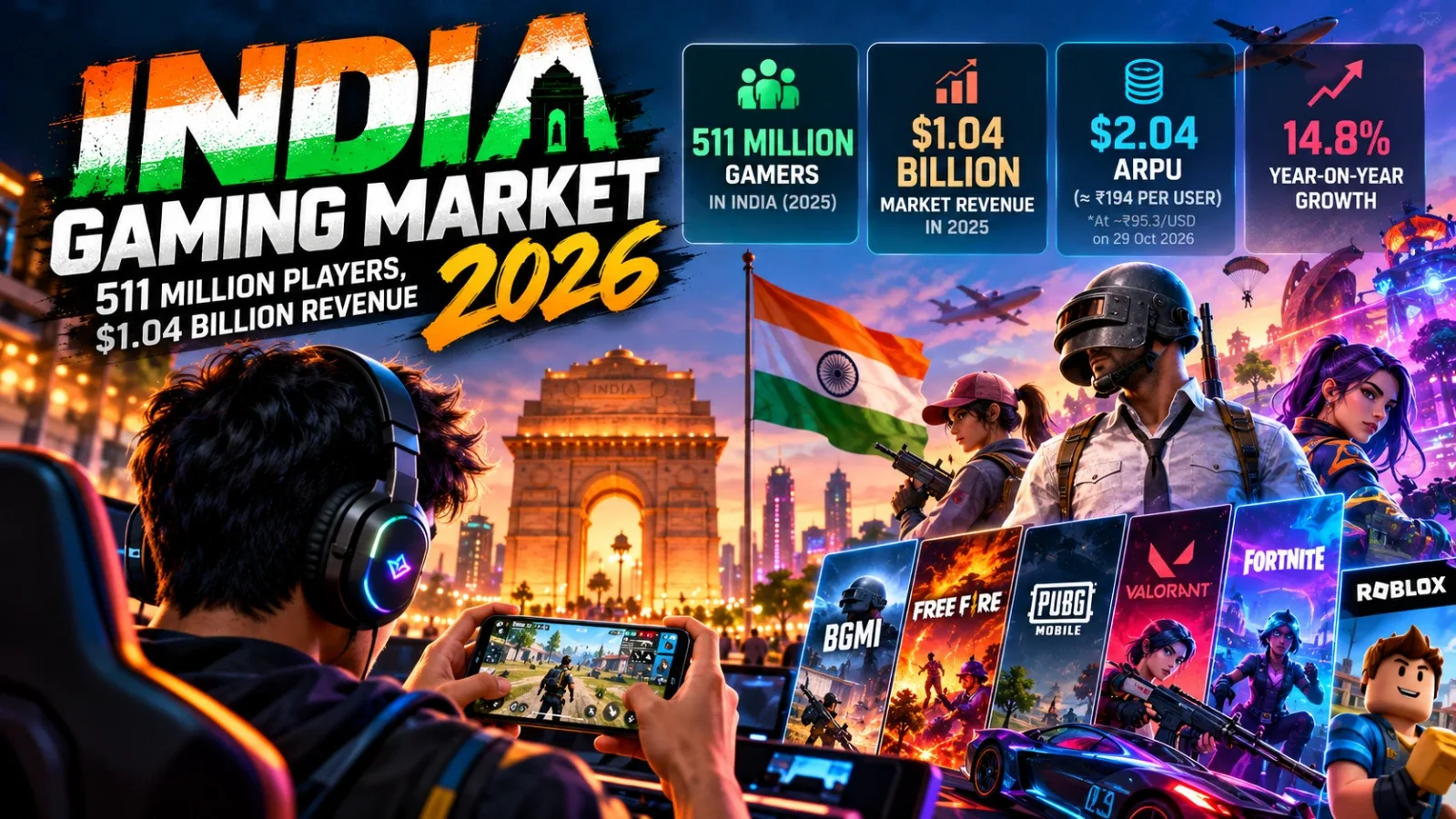
India Gaming Market 2026: 511 Million Players, $1.04 Billion Revenue and the $2 ARPU Challenge
India's gaming industry has a massive audience, but turning that audience into sustainable revenue remains a major challenge for game developers. According to the Game Developer Association of India's (GDAI) GameDev Outlook 2026 report, India's video game market generated an estimated US$1.04 billion in revenue in 2025, with 511 million players and annual revenue per user (ARPU) of just US$2.04.
Released at the India Game Developer Conference (IGDC) in Chennai on 28 October 2026, the report examines the structural challenges facing Indian game studios, including limited access to funding, publishing support, production expertise and international markets.
The report's findings highlight an important question for the industry: how can India convert its enormous gaming audience into a sustainable business opportunity for home-grown developers?
India Gaming Market 2026: Key Statistics
Here are the major figures highlighted in the GameDev Outlook 2026 report and related market research.
| Metric | Reported figure | |---|---:| | Indian video game players in 2025 | 511 million | | Estimated gaming revenue in 2025 | US$1.04 billion | | Year-on-year revenue growth | 14.8% | | Annual revenue per user (ARPU) | US$2.04 | | Studios prioritising new game IP | 82.7% | | Respondents identifying capital or publishing investment as a growth barrier | 75% | | Studios prioritising international market entry | 49% | | Studios reporting plans to expand teams over the next two years | 54.8% |
Sources: The Times of India and MediaNews4U.
The market-size figures are also consistent with Niko Partners' India gaming market research.
Important: The market statistics describe estimates for 2025, while the report's studio findings are based on survey responses and stakeholder consultations. They should not be interpreted as a census of every Indian gaming company.
Why India's Gaming Market Generates Only $2.04 per User
The headline figure is striking: India has 511 million gaming players, yet annual revenue per user stands at just US$2.04.
Using an indicative exchange rate of approximately ₹95.3 per US dollar on 29 October 2026, this is equivalent to roughly ₹194 per user per year.
This conversion is an illustration based on the exchange rate on that date, not a rupee-denominated figure published by GDAI.
It is also important to understand what ARPU measures. Average revenue per user divides total revenue by the relevant user base. It does not mean every player spends ₹194 annually, nor does it measure the average spending of paying players alone.
Some players spend regularly on premium content, while others play without making purchases. ARPU combines these different behaviours into one average.
The free-to-play business model
Free-to-play games have become an important part of the gaming landscape. Players can access the core game without an upfront purchase, while developers generate revenue through optional purchases, subscriptions, battle passes, advertising or other monetisation models.
This approach lowers the initial barrier to entry but creates a challenge: developers must build a sufficiently valuable experience to persuade a proportion of players to spend money.
The low market-wide ARPU figure highlights the gap between reaching a large audience and monetising that audience effectively.
However, ARPU alone does not reveal which monetisation model is most successful or why individual players choose not to pay.
GDAI Report Highlights Funding and Publishing Challenges
The GameDev Outlook 2026 report points to several structural obstacles that can prevent Indian studios from turning promising game concepts into commercially successful products.
1. Access to capital and publishing investment
The report identifies access to capital and publishing investment as major barriers to growth. Approximately 75% of surveyed respondents identified these issues as obstacles.
Developing a commercial game requires investment in programming, art, design, testing, marketing and ongoing updates. Studios may also need additional resources to acquire users and support a game after launch.
Without adequate funding, developers can struggle to complete projects, market their releases or sustain development after launch.
2. Limited publishing support
Publishing involves more than releasing a game on an app store. Publishers can contribute marketing expertise, distribution, user acquisition, localisation, analytics and commercial planning.
The report highlights the need for stronger publishing pathways to help Indian developers reach players in domestic and international markets.
For smaller studios, access to experienced publishing partners may be particularly important when launching a new intellectual property.
3. Gaps in production-ready talent
The report also identifies a gap between available talent and industry production requirements.
According to the survey findings, 56.7% of industry respondents considered fresh talent poorly prepared or unprepared for production requirements.
This does not mean that all new developers lack the necessary skills. Instead, the finding points to a potential mismatch between academic preparation and the practical demands of commercial game development.
Team-based projects, production pipelines, mentorship and hands-on experience can help bridge this gap.
4. Difficulty attracting international partners
The report found that 51.9% of respondents reported difficulties attracting international partners.
International partnerships can help studios access funding, distribution networks, specialist expertise and larger audiences. Building these relationships may therefore be an important part of developing globally competitive Indian game companies.
74% of Survey Responses Point to Limited Domestic Revenue
One of the report's notable findings concerns the share of studio revenue generated in India.
According to the Times of India's coverage, 74% of survey responses indicated that less than 10% of studio revenue came from domestic players.
This suggests that many participating studios rely heavily on international markets, partnerships or customers rather than generating most of their revenue from Indian players.
However, this is a survey finding, not a statement that 74% of all Indian game studios earn less than 10% of their revenue domestically.
The distinction matters because the survey reflects participating organisations and should not be treated as a complete census of the industry.
For Indian developers, the finding raises two related questions: how can domestic monetisation improve, and how can studios build stronger international businesses without becoming overly dependent on external partners?
How Developers Can Improve Gaming Monetisation
The report highlights the importance of building commercially sustainable games. The following are practical strategies developers can consider; they should not be interpreted as a verbatim list of recommendations from GDAI.
1. Introduce affordable subscriptions
A monthly or quarterly subscription can bundle selected cosmetics, in-game benefits or access to exclusive activities.
The value proposition should be clear, and subscriptions should provide ongoing benefits rather than relying solely on artificial scarcity or pressure to renew.
Developers should test different price points and measure renewal rates, customer satisfaction and long-term revenue.
2. Design balanced free and premium battle passes
Battle passes can offer free and premium reward tracks. Players who do not pay should still have a meaningful gameplay experience, while the premium track can offer additional cosmetic items and other clearly described benefits.
Pricing should reflect the value of the content, the game's audience and local purchasing power. A ₹199–₹299 price range can be tested as a hypothesis, but it is not a proven optimal price for every Indian game.
3. Simplify local payments
Payment methods should match the preferences of the intended audience. UPI, supported digital wallets and other locally available options can make transactions more convenient.
Niko Partners' research reports widespread UPI usage among Indian players. However, payment-method adoption alone does not explain low ARPU, and developers should avoid assuming that adding another payment option will automatically increase spending.
Studios should evaluate payment completion rates, failed transactions, refunds and repeat purchases before and after introducing new options.
4. Create culturally relevant events
Indian festivals such as Diwali and Holi can provide opportunities for themed events, seasonal cosmetics and community activities.
Well-designed events can strengthen engagement when their content fits the game and its audience. Developers should also ensure that limited-time offers remain transparent and that players understand the conditions attached to rewards.
5. Build original intellectual property
The report found that 82.7% of surveyed studios prioritised launching new game intellectual property, while 49% prioritised entering international markets.
Original IP can give developers greater control over their characters, worlds, branding and future products. It can also create opportunities for sequels, merchandise, licensing and other extensions.
However, original IP requires long-term investment and does not guarantee commercial success. Studios need to validate their concepts, understand their target audiences and plan distribution before committing significant resources.
What the Findings Mean for Indian Esports
Low average revenue per user can raise questions about the commercial sustainability of games and esports ecosystems, but it does not automatically mean tournament prize pools will decline.
Esports funding can come from multiple sources, including sponsors, publishers, tournament organisers, franchise arrangements, advertising, media rights and community support.
The impact of gaming monetisation on tournament funding depends on the business model of each game and the arrangements between its publisher and esports partners.
Why sponsorship and publishing partnerships matter
For tournament organisers, diversified revenue sources can reduce dependence on any single income stream.
Publishers and sponsors can support competitions through cash prizes, production budgets, promotional campaigns and other contributions. Stronger partnerships may help sustain events even when direct in-game monetisation is limited.
What this means for aspiring professional players
Players should not assume that prize money will necessarily fall because India's overall ARPU is low. Prize pools vary considerably across games, events and sponsors.
Aspiring professionals should evaluate tournament rules, qualification pathways, organiser credibility and the consistency of competitive opportunities rather than relying on market-wide ARPU figures alone.
The GDAI report identifies wider industry funding and publishing challenges, but the available findings do not establish a direct causal link between India's $2.04 ARPU and declining esports prize pools.
What Indian Gamers Can Expect Over the Next Year
The report highlights opportunities for Indian game developers, but specific future prices, events and infrastructure upgrades depend on individual companies and their investment decisions.
Here are several developments worth watching.
More original Indian games
With 82.7% of surveyed studios prioritising new intellectual property, original games may remain a major focus for participating developers.
The opportunity extends beyond battle royale titles to casual games, strategy games, simulation, narrative experiences and other genres.
Greater focus on international markets
The report found that 49% of surveyed studios prioritised international expansion.
For developers, this may mean investing in localisation, international publishing, user acquisition and products designed to appeal to players beyond India.
Stronger talent development
The findings on production-ready skills suggest that practical training, collaborative development and industry mentorship could play an important role in preparing future game developers.
New approaches to monetisation
Studios may experiment with subscriptions, battle passes, optional purchases and other revenue models. Which approaches work best will depend on the game's genre, audience, engagement patterns and perceived value.
Opportunities beyond metropolitan cities
The report noted that 41.3% of industry submissions came from Tier-II and Tier-III locations. This highlights the geographical spread of participating industry voices and the potential for game-development talent beyond major metropolitan centres.
Frequently Asked Questions (FAQs)
1. What is the size of India's gaming market in 2025?
India's video game market generated an estimated US$1.04 billion in revenue in 2025, according to GDAI's GameDev Outlook 2026 report and Niko Partners' market research.
2. How many gamers are there in India?
India had an estimated 511 million video game players in 2025. The figure represents the estimated player base, not the number of people who pay for games.
3. What is India's gaming ARPU in 2025?
The reported annual revenue per user was US$2.04. At an indicative exchange rate of ₹95.3 per dollar on 29 October 2026, that is approximately ₹194 per user per year.
4. Does $2.04 ARPU mean every Indian gamer spends ₹194?
No. ARPU represents average revenue across the relevant user base. Individual players may spend nothing, spend occasionally or make frequent purchases.
5. What is the GDAI GameDev Outlook 2026 report?
It is an industry report released by the Game Developer Association of India at the India Game Developer Conference in Chennai in October 2026. It examines India's gaming market and the challenges facing game studios, including funding, publishing, talent and market access.
6. What percentage of surveyed studios prioritise new game IP?
According to the report's coverage, 82.7% of surveyed studios identified launching new intellectual property as a priority.
7. Why is monetisation a challenge for Indian game developers?
The report highlights low willingness to pay, limited access to capital, publishing investment gaps and difficulties building commercially successful games. These issues can make it harder for studios to convert a large audience into sustainable revenue.
8. Will low gaming ARPU reduce Indian esports prize pools?
Not necessarily. Prize pools depend on several factors, including sponsorships, publisher funding, tournament economics and other commercial arrangements. The available report findings do not establish that low ARPU directly causes prize pools to decline.
9. How can Indian game developers increase revenue?
Potential approaches include improving player retention, offering valuable optional purchases, testing subscriptions, simplifying payments, developing original IP and expanding into international markets. The right strategy depends on each game's audience and business model.
Final Verdict: India's Gaming Opportunity Goes Beyond Player Numbers
India's gaming market reached an estimated US$1.04 billion in 2025, with 511 million players and annual revenue per user of US$2.04. The figures highlight both the scale of the audience and the challenge of building sustainable businesses around it.
GDAI's GameDev Outlook 2026 report points to funding, publishing support, production-ready talent and international market access as important priorities for the industry.
For developers, the opportunity is not simply to attract more players. It is to create games that people value, build sustainable monetisation models and establish original intellectual property with long-term potential.
India's large player base provides a significant foundation. Turning that reach into globally competitive game studios will require investment, practical skills, effective distribution and a deeper understanding of player behaviour.
Sources: The Times of India, Niko Partners, MediaNews4U, and DT Next.
Sources
We research each story from these reports and write it in our own words.